


Why scrap preparation is a melting decision
Aluminium recycling plants increasingly need to process feedstock with different geometries, alloy families and surface conditions. A load of used beverage cans (UBCs) behaves differently from clean extrusion profiles, oily turnings or coated sheet. The decision to install or upgrade a decoating stage therefore begins with scrap characterisation—not with the selection of a kiln.
Paint, lacquer, lubricants, oil and other organic residues can influence furnace operation, off-gas management and the preparation needed before melting. Thermal decoating aims to remove these substances upstream, so that melting receives a more consistent metallic fraction. The outcome depends on the incoming mix, operating conditions and the configuration of the full recycling line.
Which aluminium scrap streams should engineers evaluate?
GME’s technical material identifies UBC, profiles, lithographic material, laminates and chips among the streams relevant to decoating, while the wider aluminium recycling portfolio encompasses castings, rods, engine blocks and additional scrap types. The supplied ideal-mix list also includes window profiles, Tense castings, rod/wire, offset sheet, extrusion, Taint Tabor, Taboo, Toto, pure coil, oil-contaminated Telic turnings and clean Teens turnings.
This is a feedstock assessment list, not a statement that every grade needs the same thermal treatment. Clean metal may have little organic load; oily chippings have distinct handling and safety considerations; cast or mixed loads require additional alloy and contamination analysis. Operators should examine representative samples, organic content, moisture, fines, particle-size distribution and the desired output specification before determining the suitable route.
How the GME rotary decoating process works
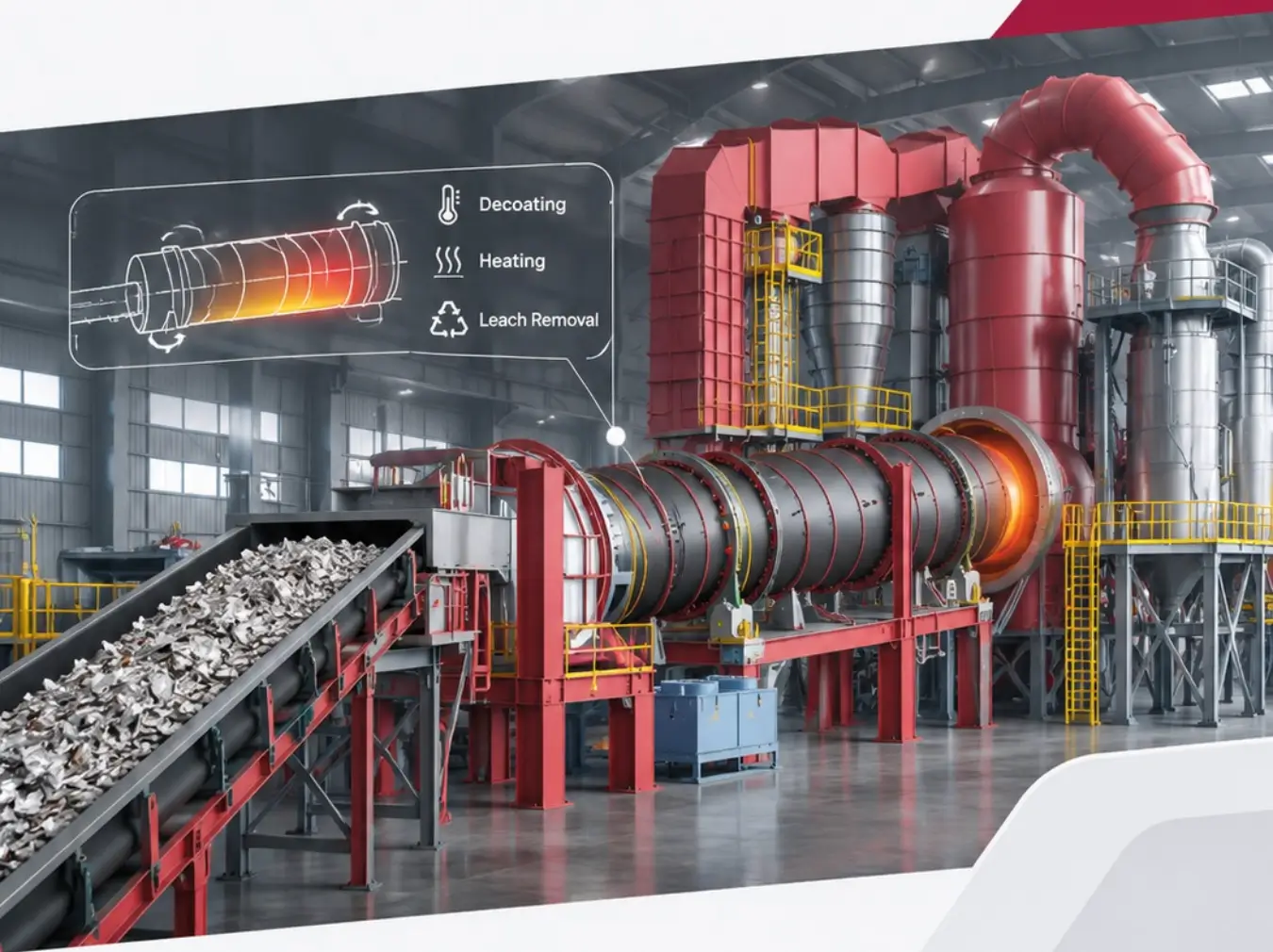
The GME process description presents a pyrolytic, rotary-kiln-based treatment designed to remove organic coatings before the metal enters downstream operations. The stated architecture includes a feeding system, kiln, burner, afterburner, heat exchangers, exhaust-gas recirculation fan and dedusting cyclone. The accompanying line description also includes downstream screening and exhaust-gas treatment.
GME describes a closed-loop, counterflow approach in which energy from organic residues contributes to process heat. Its technical presentation refers to combustion of carbon-based gases around 550°C in the kiln; that reference should not be interpreted as a universal setpoint for every feedstock. Temperature profile, oxygen availability, pressure control, residence time and actual organic loading must be evaluated for each design.
Particle size and throughput: avoid a one-size-fits-all assumption
Shredding intensity affects electricity consumption, material handling and kiln behaviour. GME documents a design allowance for scrap pieces up to 250 mm and highlights internal paddles used to move and mix the load. This does not mean that any 250 mm object, geometry or mix is automatically acceptable: feeding stability, bulk density, coatings, fines and upstream separation must still be checked.
The source presentation identifies UBC plant sizes from 5 to 20 tonnes per hour. These are described ranges for GME’s UBC offering, not a guaranteed nominal capacity for all scrap families or configurations. Technical sizing should be based on a defined feedstock envelope and a documented operating case.
Energy performance: what the claims actually mean
In its supplied technical presentation, GME states that operation with organic content above 5% can avoid natural-gas use for the decoating process, and quotes 20–28 Nm³ of natural gas per tonne of charged scrap below that threshold. The material compares this with a stated market reference of 55–65 Nm³/t and an indicative 55–60% saving. These are manufacturer figures, not independently verified results or universal guarantees.
A project-specific assessment should clarify the measurement boundary, the feedstock composition, throughput, start-up energy, auxiliary loads, afterburner duty, thermal recovery and any gas used elsewhere in the melting line. The relevant decision metric is total energy per tonne of acceptable output at the required quality—not a single isolated burner figure.
Metal recovery and oxidation: validate with a mass balance
GME describes the objective as reducing dross creation and metallic oxidation before smelting. Its presentation also uses the phrase “zero oxidation”; for investment evaluation this should be treated as a supplier performance claim, to be tested against a specified input and operating condition. Metal recovery cannot be inferred from the brightness of decoated scrap alone.
A defensible trial records input mass and chemistry, separated fines, off-gas and dust-related fractions where measurable, material entering melting, dross produced, tapped metal and final metal quality. Consistent sampling and clear measurement boundaries make comparisons between operating scenarios meaningful.
Integrating decoating with emissions control and melting
A decoater is part of an industrial system, not a stand-alone appliance. The engineering scope typically includes scrap reception, size reduction or debaling where required, conveyors and safety interlocks, thermal treatment, off-gas handling, downstream screening and transfer to the melting system. GME’s technical document describes afterburning, heat exchange, bag filters and treatment of acidic gases using lime or sodium bicarbonate in a reactor.
The selected emissions strategy must reflect actual feedstock contaminants, applicable permits and the whole line’s gas balance. Plant layout must also address access for maintenance, controls integration, emergency discharge, fire prevention and commissioning interfaces.
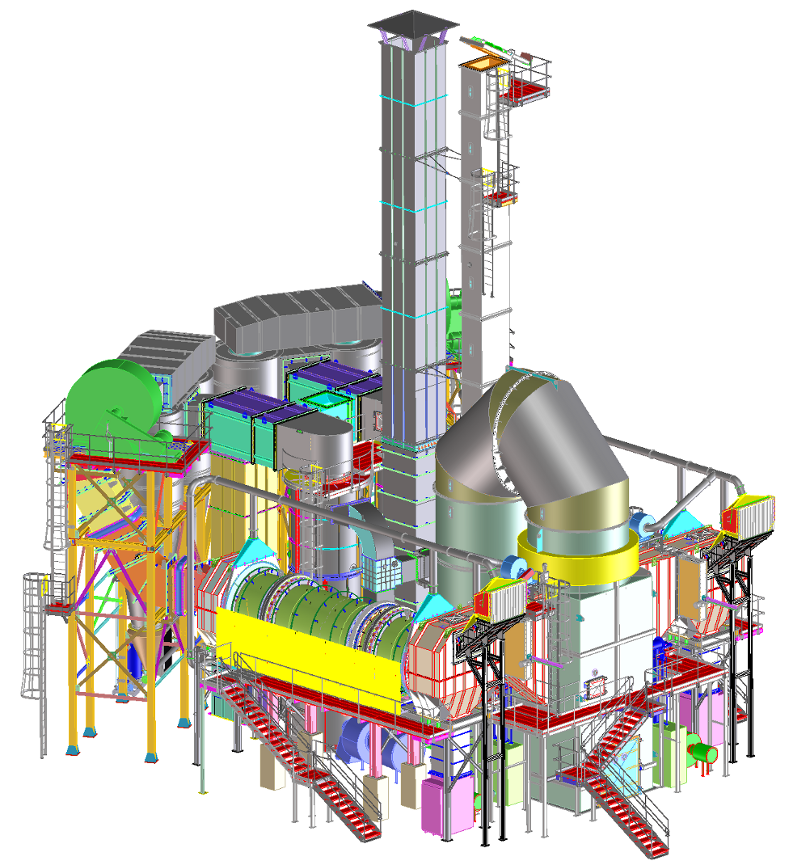
Figure 1. GME rotary decoating system — engineering rendering supplied by GME.
A practical RFQ checklist for plant managers
Before requesting quotations, define:
(1) annual and hourly throughput profiles;
(2) the percentage of each scrap grade and expected organic load;
(3) particle-size and bulk-density ranges;
(4) moisture and contamination limits;
(5) output cleanliness and melting requirements;
(6) energy and emissions measurement boundaries;
(7) available plant footprint and utilities;
(8) downstream furnace configuration;
and (9) test protocol, acceptance criteria and maintenance expectations.
A clear RFQ lets suppliers propose solutions against comparable conditions and helps investors judge operating risk—not just installed capacity.
How GME Recycling supports technical evaluation
GME Recycling’s decoating and delacquering technology can be considered alongside the company’s wider aluminium preparation and melting-line engineering. Its documentation illustrates both detailed process components and integrated layouts, including rotary treatment, heat recovery and gas handling. Plant-specific performance should be established through the engineering review and agreed feedstock testing.
GME_Recycling_Whitepaper_Decoating_Layout_10_pages
For a more detailed selection framework, download the companion technical whitepaper, “Rotary Kiln Decoating for Aluminium Recycling: Engineering Parameters, Integration and Evaluation Checklist”, and contact the GME engineering team to discuss your scrap mix and project conditions.
Frequently asked questions
Is thermal decoating necessary for every aluminium scrap grade?
No. The decision depends on coating and organic content, downstream furnace requirements, product specifications and the economics of the complete plant.
Can a rotary decoater process oversize scrap?
GME describes an input-size design allowance up to 250 mm; actual suitability requires verification of geometry, mix and feeding conditions.
How much energy can decoating save?
Savings are scenario-dependent. GME publishes conditional natural-gas figures for organic load bands; verify the full energy boundary and test conditions.
Does decoating eliminate oxidation?
GME makes a “zero oxidation” performance claim in its presentation. Validate oxidation, dross and metal recovery by measured trials and an agreed mass balance.
Comments are closed.

